
Introduction to Data Analysis Tools and R Programming
Course
Learn R programming for statistical computing, graphics, data analytics and scientific research.
Grab the knowledge by learning the techniques of deep learning tools - Keras.
R Programming:
This section covers the overview of R programming. Learn the techniques of Visualization and Statistics through R programming language.
🎉 Ready to start your child’s coding adventure? Get started with Data Analysis Tools and R Programming today!
3 Level | Age 13+
Choose Your Level
Select the level that best fits your learning journey
Introduction to Data Analysis Tools and R Programming
Step into the world of data analytics with Introduction to Data Analysis Tools and R Programming! This course provides students with a comprehensive foundation in analyzing, interpreting, and visualizing data using powerful tools and the R programming language. Learners will explore how to handle datasets, perform statistical analysis, and extract meaningful insights to support decision-making in real-world applications.
Level 1 Syllabus
-
R Programming – Basics & Data Analysis
a. Introduction & Setup
-
Introduction to R Programming
-
R Installation
b. Data Types & Structures
-
Data Types and Data Structures
-
Variables and Operators
c. Control Flow & Statements
-
If-Else and Else-If Statements
-
R Switch Statement
-
Next, Break, and Other Statements
d. Collections & Data Structures
-
R Vectors and R Lists
-
R Arrays and R Matrix
-
R Data Frame and R Factors
-
R Data Reshaping
e. Advanced Concepts
-
Object-Oriented Programming
-
R Debugging
-
R Data Interfaces
-
R Data Visualization
-
R Regression
-
R Statistics
f. Mini Projects / Examples
-
Pirate Face
-
-
Keras – Deep Learning with Python
a. Introduction & APIs
-
Introduction to Keras
-
Introduction to APIs
-
Functional API
-
Model API
-
Layer API
-
Callbacks API
b. Data & Training
-
Data Preprocessing & Optimizers
-
Working with RNN
-
Keras Applications
-
Training Keras Models with TensorFlow Cloud
-
🎯 Major Projects (Level 1)
Statistics Project and Keras Application
Advance your data science and machine learning skills with Statistics Project and Keras Application! In the Statistics Project, students will apply statistical concepts to analyze real-world datasets, interpret trends, calculate probabilities, and make informed decisions based on data insights. This hands-on project strengthens understanding of descriptive and inferential statistics, hypothesis testing, and data visualization techniques.
In the Keras Application module, learners will dive into deep learning by building and training neural networks using Keras, a high-level Python library. Students will explore tasks such as image recognition, classification, and predictive modeling, gaining practical experience in designing models, adjusting hyperparameters, and evaluating performance.
Data Mining and Tableau Tool
Unlock the power of data with Data Mining and Tableau Tool! This course introduces students to the processes of extracting meaningful patterns, trends, and insights from large datasets using data mining techniques. Learners will explore concepts such as classification, clustering, association rules, and anomaly detection to uncover hidden knowledge and support informed decision-making.
In parallel, students will gain hands-on experience with Tableau, a leading data visualization tool. They will learn to create interactive dashboards, charts, and graphs, transforming complex data into visually appealing and easy-to-understand insights. This combination of data mining and visualization equips learners to analyze and present data effectively.
Level 2 Syllabus
-
Machine Learning with Scikit-Learn
a. Introduction & Setup
-
Introduction to Scikit-Learn
-
Introduction to ML using Scikit-Learn
-
ML: The Problem Setting
b. Learning Types & Models
-
Supervised Learning
-
Unsupervised Learning
-
Model Selection and Evaluation
-
Inspection
c. Data Handling & Utilities
-
Dataset Transformation
-
Dataset Loading Utilities
-
Computing with Scikit-Learn
-
-
Data Mining
a. Basics & Terminology
-
Introduction to Data Mining
-
Algorithms, Tasks, and Issues
-
Terminologies, Knowledge Discovery, and Query Language
b. Classification & Prediction
-
Classification and Prediction
-
Decision Tree Induction
-
Bayesian Classification
c. Advanced Mining & Bonus Classes
-
Text Data Mining
-
Web Mining
-
Bonus Class: Regular Expression
-
Bonus Class: File Operations
-
-
Computer Vision with OpenCV
a. Introduction & Setup
-
Introduction to Computer Vision and OpenCV
-
Downloading and Installing OpenCV
b. Image Processing Basics
-
Basic Operations on Images
-
Rotating the Images
-
Drawing Functions
-
Edge Detection
-
Gaussian Blur
-
Image Filtering and Threshold
-
Mouse Event
-
Template Matching
c. Video & Advanced Applications
-
Video Capture
-
Face Recognition and Detection
-
Emotion Detection Project
-
Project Submission
-
🎯 Major Projects (Level 2)
Emotion Detection and Face Recognition
Step into the advanced world of computer vision and AI with Emotion Detection and Face Recognition projects! In the Emotion Detection project, students will learn to build models that can identify human emotions such as happiness, sadness, anger, or surprise from images or video streams, combining deep learning, image processing, and neural networks. The Face Recognition project focuses on detecting and recognizing individual faces, teaching learners how to implement biometric identification systems using Python libraries like OpenCV, dlib, and TensorFlow/Keras.
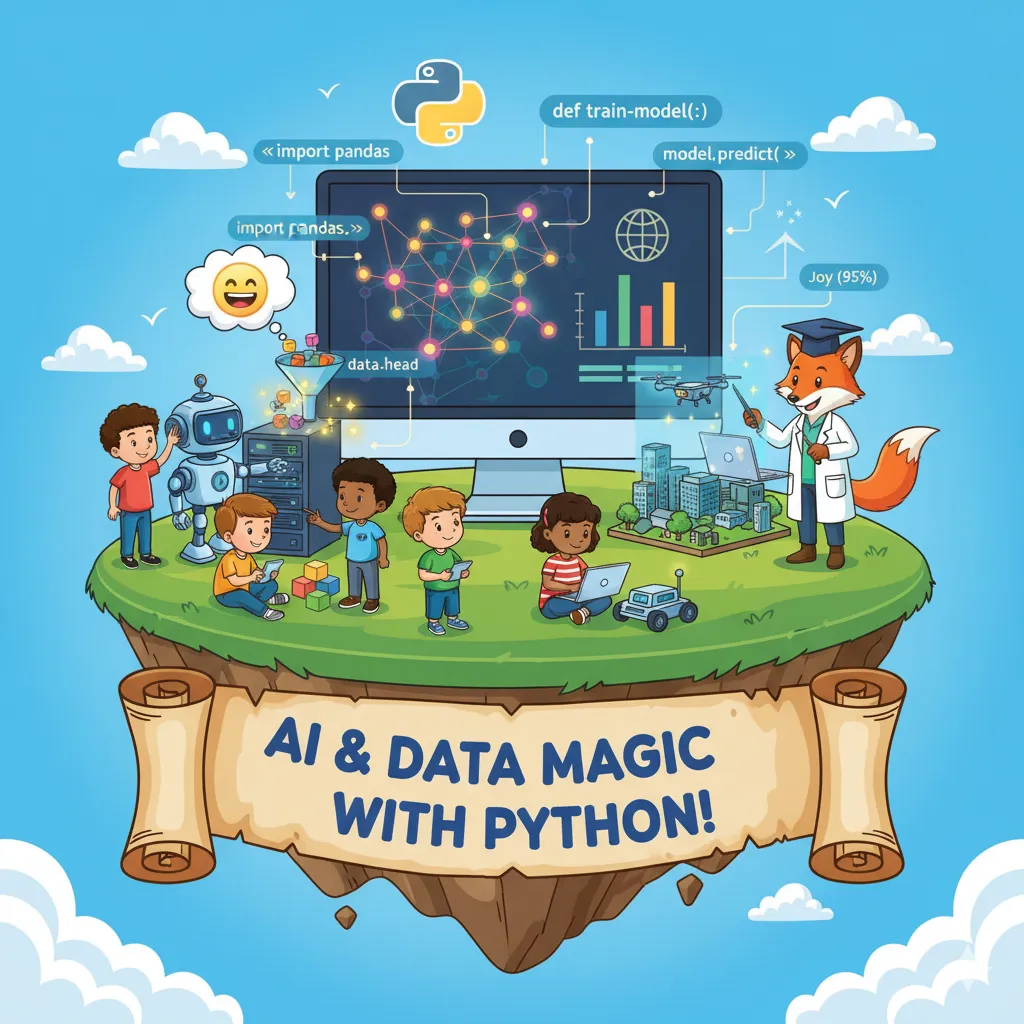
AI & Data Science Projects Using Python
Dive into the world of AI and Data Science with hands-on projects using Python! This course empowers students to apply artificial intelligence and data science concepts to real-world problems, combining coding, analysis, and predictive modeling. Learners will explore projects such as predictive analytics, recommendation systems, image and text analysis, sentiment analysis, and more, gaining practical experience in building intelligent applications.
Level 3 Syllabus
-
Data Visualization with Tableau
a. Introduction & Setup
-
Introduction to Data Visualization and Tableau
-
Tableau Data Types and Sources
b. Worksheets & Calculations
-
Tableau Worksheets
-
Tableau Calculations
-
Tableau Sorting and Filtering
c. Charts & Visual Analysis
-
Tableau Charts
-
-
Data Science Projects
Road Lane Line Detection
-
Credit Card Fraud Project Using R
-
Fake News Prediction Project
-
Car Price Prediction Project
-
Heart Disease Classification
🎯 Major Projects (Level 3)
Car Price Prediction and Heart Disease Classification
Step into the practical applications of AI and Machine Learning with Car Price Prediction and Heart Disease Classification projects! In the Car Price Prediction project, students will learn to analyze automotive datasets, identify important features, and build predictive models to estimate car prices based on specifications, market trends, and other factors. This project emphasizes regression techniques, data preprocessing, and evaluation metrics for accurate predictions.
The Heart Disease Classification project focuses on healthcare applications, teaching students to use machine learning algorithms to predict the likelihood of heart disease from patient data. Learners will explore classification techniques, feature selection, model training, and performance evaluation to create reliable predictive models.